Work Experience
Here’s my professional journey so far.
Here’s my professional journey so far.
I’m a backend-focused software engineer with experience building production systems that handle access control, background data processing, and integration between services.
My work involves designing and implementing backend logic that supports business-critical workflows — managing permissions, coordinating asynchronous processes, and ensuring data remains consistent and reliable across systems. I’ve worked on software where correctness, security, and long-term stability matter more than quick feature delivery.
I tend to think in terms of systems rather than isolated features: how components interact, how state is managed, and how software behaves as usage increases or requirements evolve.
I’ve worked on backend and platform systems in financial services, and I also build independent systems and tools to explore ideas that interest me.
Here’s what I typically work with.







































My portfolio website to show off my skills, projects, experience and to take control of my "CSSphobia".
BunFiberGoNext.jsPodmanPostgreSQLTailwind CSSTypeScriptVercelZod
I created this application to manage my day-to-day expenses.
ASP.NET CoreBunC#gRPCNext.jsOracle CloudPodmanPostgreSQLReact RouterReact.jsTailwind CSSTanstack EcosystemTypeScriptVercelZod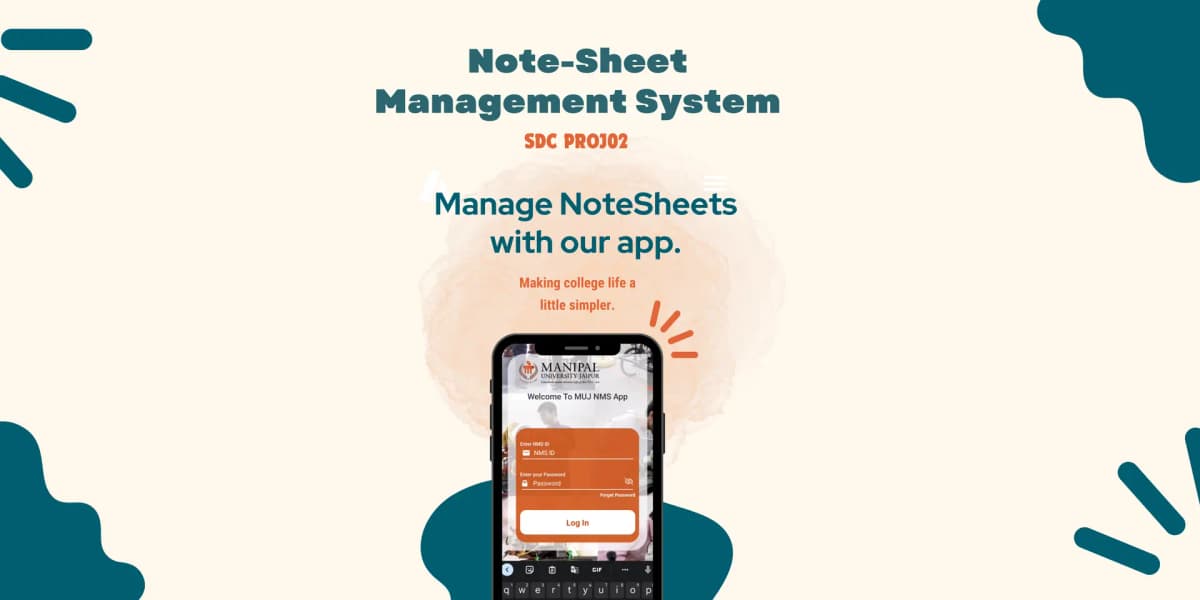
I created the backend and handled the deployment for this project. Its goal is to automate and digitalize how notesheets are managed at my university. This involved setting up the system and making sure everything ran smoothly, which helped make the whole process more efficient and easier to handle. This project secured 1st place in the Software Development category under Minor Project at my university and is currently awaiting an Indian patent grant.
ExpressJavaScriptNode.jsPostgreSQLReact RouterReact.jsTailwind CSS
I created this project as part of my academic curriculum, working with Anshul Sharma. I handled the web development side using Express, while Anshul took care of the AI part with Python. We used both technologies because we needed Python to train a customized model and Express for the web development. Additionally, we provided an option to use an external service whose SDK was only available in JavaScript at that time. We collaborated to build the project, each focusing on our areas of expertise. It was a great way to apply what we learned and work together on something practical.
ExpressJavaScriptNode.jsPythonTailwind CSS
For my internship at the Language and Cognition Lab at IIT Kanpur, I implemented an algorithm to generate Hindi pseudowords and created a user interface in the form of a web app using Jinja templates. This involved designing a simple and effective UI to display the generated pseudowords and ensuring that the algorithm worked smoothly.
FlaskPython
I created this application to manage my portfolio website.
BunGogRPCOracle CloudPodmanPostgreSQLReact RouterReact.jsRedisTailwind CSSTanstack QueryTypeScriptVercel
During my internship at Blowbits Solutions LLP, I designed and developed a customer support ticketing system from scratch for both end-users and agents, building RESTful APIs using ASP.NET Core and frontend components in React, with PostgreSQL for data storage and deployment on AWS.
Amazon Web ServicesASP.NET CoreBunC#PodmanPostgreSQLReact.jsRedisTailwind CSSTanstack EcosystemTypeScriptZodZustandDuring my internship at Blowbits Solutions LLP, I built a complete attendance and leave management system using ASP.NET Core, React, PostgreSQL, and AWS, creating foundational HR functionality including API design, database schema, and responsive UI.
Amazon Web ServicesASP.NET CoreBunC#PodmanPostgreSQLReact.jsRedisTailwind CSSTanstack EcosystemTypeScriptZodZustandDuring my internship at Blowbits Solutions LLP, I engineered a CAPTCHA recognition microservice using ASP.NET Core, ONNX Runtime, and Emgu.CV, integrating a pre-trained CNN model for automated text extraction, with a focus on backend service design, image processing, and deployment on AWS.
Amazon Web ServicesASP.NET CoreC#Python PyTorch
During my internship at Techwondoe, I worked on the backend of a project using NestJS to handle requests from the frontend and GraphQL to fetch data from HubSpot CRM. The frontend, built with Next.js, communicated with NestJS through REST APIs, which then used GraphQL to interact with HubSpot.
GraphQLNestJSNode.jsTypeScript
During my internship at Techwondoe, I worked on the backend of this project using NestJS, PostgreSQL, and TypeORM. I developed a microservice for notifications and created endpoints for other microservices like user management, opportunity management, etc. Additionally, I designed and implemented logic to sync AWS Cognito users with Salesforce users in the database. Users could log in through either Cognito or Salesforce. If a user registered with Cognito, it provided an NCS variant of UUIDv7, while my custom algorithm generated UUIDs for Salesforce registrations. I implemented a system to generate NCS-compliant UUIDs and ensured proper validation. I also handled edge cases, such as resolving conflicts if a user registered first with one service and later with the other.
NestJSNode.jsPostgreSQL TypeORMTypeScript
Because 'Access Denied' is merely a suggestion, I engineered this Go-based stealth relay to retrieve absolutely anything through strict firewalls by disguising traffic as boring system noise. It features TOTP authentication for zero-trust access, traffic camouflage to bypass Deep Packet Inspection, and Range support to ensure massive downloads can be resumed on unstable connections. It turns a locked-down network into an open highway—one byte at a time.
GoOracle CloudBuilt a Go-based CLI tool using Gemini AI to transform natural language into cross-platform shell commands, featuring automatic OS/shell detection and safety-focused side-effect analysis.
Go